“Cannabis is the single most versatile herbal remedy, and the most useful plant on Earth. No other single plant contains as wide a range of medically active herbal constituents.” – Dr. Ethan Russo, Neurologist, Botanist and Cannabis Expert ; President, International Association for Cannabinoid Medicine
What is ALS?
Imagine one day that you are seemingly enjoying perfect health. Then all of a sudden, you notice that your hand is shaky. In a matter of months other muscles in your body are twitching, then your speech becomes heavy and you start to notice that breathing isn’t as easy as it once was. It becomes difficult to do simple tasks like bathe and clothe yourself. Even a few trips to the doctor yield no result. Lifting of any kind seems impossible. You have no energy and find yourself laughing and or crying uncontrollably for some unknown reason. Before you know it, your body is weak, your muscles have atrophied to the point you are a shell of your former self. You can no longer breathe on your own and require a ventilator to live and you are confined to a wheel chair where you sit idly, drooling and unable to control your body. This is the work of the horrific disease of Amyotrophic Lateral Sclerosis (ALS). While no two people will have the same experience of the symptoms that I mentioned above, they will all suffer many indignities associated with their ability to move, eat, speak and breathe. And most will die of respiratory failure.
ALS, also known as Lou Gehrig’s Disease, generally strikes people between the ages of 40-70. A degenerative motor neuron disease, ALS according to the ALS Association, “affects the motor neuron cells in the brain and the spinal cord.” When the motor neurons die, the brain can no longer initiate nor control muscle movement.
 Two people in 100,000 are diagnosed with ALS or approximately 5,600 people per year. At any given time there are 30,000 Americans suffering with ALS. Thanks to the ALS Association Ice Bucket Challenge, over $50 Million have been raised to research this terrible disease. To date, pharmaceuticals barely provide any modicum of relief to these patients and certainly do not offer a slowing or cessation of the development of the disease. There is NO cure. These patients often experience rapid health decline causing immense stress for the patient and their loved ones. It is rare for someone to live with this disease 7-10 years after diagnosis.
Enter the cannabis plant…This safe, effective and non-toxic herb offers some hope to those with ALS.
How Cannabis Benefits ALS Patients

Cannabis is both an anti-oxidant and a neuroprotectant as documented in the federal government’s patent 6,630,507 on cannabis. In the case of ALS, this is critically important because the neuroprotectant and anti-oxidant properties of cannabis may help slow the progression of the disease by protecting the motor neurons the disease attacks and kills (Gregory T. Carter 201). The anti-oxidant properties of cannabis help reduce the oxidative stress at a cellular level that contributes to cell death.
Animal research has shown that both synthetic and plant derived THC (one of the many active components of the cannabis plant and the primary psychoactive component – see Cannabinoid & Terpene section below) counteracted neurodegeneration (Stephen Byer 2013). This research has not yet been conducted in human clinical trials but a study by Dr. Mary Abood has shown that symptomatic relief was measured for appetite, insomnia and spasticity in ALS patients (Stephen Byer 2013). The two studies and the large body of scientific work that has already been conducted prove the safety of cannabis warrants further investigation of cannabis and cannabinoids for treatment of ALS.
From a symptom management or palliative care perspective, cannabis can provide great relief for ALS patients. The symptoms of ALS that cannabis can help address are as follows:
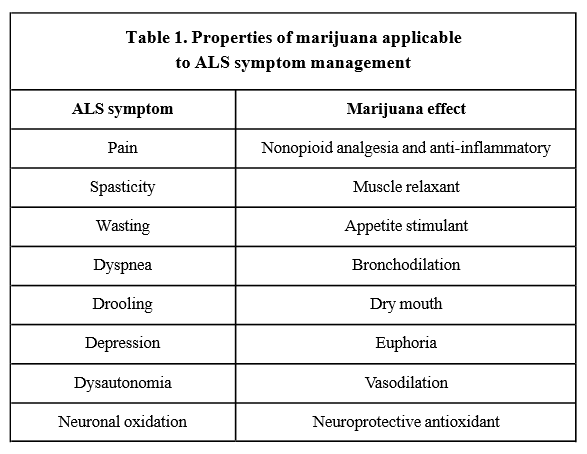
Image Source: (Gregory T. Carter 201)
Dr. Gary T. Carter, Medical Director of the St. Luke’s Rehabilitation Institute in Spokane Washington, gave a presentation at the 2014 Patient’s Out of Time Eighth National Clinical conference on Cannabis Therapeutics that addressed the use of cannabinoids for the treatment of ALS and other neurodegenerative disorders. Speaking about the safety and efficacy of cannabis for ALS, Dr. Carter said, “we know more about cannabis than 95% of other medicines. Cannabis is custom made to treat ALS (Carter 2014).” Dr. Carter is an expert in treating neuromuscular disorders and has seen many ALS patients benefit from the use of cannabis.
Cannabinoids & Terpenoids
Cannabinoids are the primary pharmaceutically active chemical in the cannabis plant. There are over a 100 that have been discovered but only a handful have been well researched. The two most common cannabinoids are delta-9 tetrahydrocanbinol (THC) and cannabinol (CBD). Each of these cannabinoids are important in the management of ALS.
THC is the primary psychoactive component of cannabis and can be helpful in reducing inflammation and pain. CBD dampens the negative effects of THC (rapid heartbeat/unwanted psycho-activity), and provides a happier high than with just THC alone. CBD helps relieve muscle spasms, is an anti-inflammatory and a more powerful anti-oxidant than vitamins C or E (Russo 2010). Other important cannabinoids to ALS suffers include cannabinol (CBN) and anti-convulsant, tethrahydrocannabivarin (THCV) an anti-inflammatory, cannabichormene (CBC) an anti-inflammatory, analgesic (pain killer) and promotes brain growth, and cannbicyclol (CBL) a pain killer (Carter 2014).
Every cannabis sample will have a different chemical make-up of a variety of active chemical components including cannabinoids and terpenes. Terpenes are the most widely occurring class of chemicals in nature and are considered safe by the FDA. You find them in lemon, lavender and pine trees to name a few. Terpenes in cannabis are thought to provide a synergistic effect with the cannabinoids, meaning some of the “therapeutic effect” of cannabis and much of the experience of the “high” are driven by the terpenes.
If you don’t like the experience of a particular plant sample, try another one. In states where cannabis is legal, be sure to buy cannabis that has been tested for safety and that provides a chemical profile of the percentages of the different cannabinoids and terpenes present in the sample you buy. This will go a long way in helping determine a strain of cannabis that provides the desired effect.
Each human body is different and will respond differently to the different chemical make-up in each plant sample. It may take a while to find the best plant material, chemical ratios and intake methods for the patient. Although cannabis is classified as a Schedule 1 drug and considered to have “no known medical value” according to the Drug Enforcement Agency, cannabis is considered to be one of the safest and most active pharmacologically active plants on the planet. It is a safe and versatile medicine with no lasting side-effects and very low toxicity.
Cannabis Intake Methods for ALS Patients
Talk to your doctor about what will be best for you. If you do not have a doctor in your area, see if you can find a cannabis savvy physician who will give you a consult over the phone. The following are some of the primary intake methods of cannabis.
Inhalation – One of the benefits of using inhaled cannabis to treat these symptoms is that one will get relief almost immediately and have the ability to titrate the medicine as they need. The most popular ways of using inhaled cannabis are via a cannabis cigarette called a joint, a pipe or a bong. Each of these methods directly combust the plant material creating bi-products such as smoke and tars that can irritate the lungs. A gadget called a vaporizer is thought to be a much better choice for anyone using cannabis for therapeutic use. A vaporizer heats the plant material to a certain temperature that activates the cannabinoids releasing them and their complementary terpenes into a clean vapor that can be inhaled with considerably less potential for irritation.
Edibles – Cannabis edibles are preferred by some patients because they get both a stronger effect from the cannabis and sustained relief. It is important to note that when cannabis is ingested it must be metabolized in the liver which can take 30 minutes to three hours depending on one’s body chemistry, potency of the edible and amount of food in their system. It is much more difficult to titrate a cannabis edible than when vaporizing. It may take some time and practice to find the right dose. Each patient is different and therefore, so will their therapeutic dose. Over-consumption of a cannabis edible can be fairly uncomfortable. Avoid this by starting with extremely small doses and waiting three hours before taking more. Depending on one’s body chemistry, the potency of the plant material and the amount of cannabis consumed, an edible can provide sustained relief for 6-9 hours.
Tinctures -Tinctures are suitable for feeding tubes (Carter 2014). In this case, and in the case of patients swallowing the cannabis tincture, the tincture will be processed and metabolized in the body in the same way as a cannabis edible providing similar activation and relief times. If the tincture is taken under the tongue it will move the blood brain barrier almost immediately acting more quickly in a similar fashion to inhaled cannabis. The patient may experience 45 minutes to 3 hours of relief depending on their chemistry, dose, and tincture potency.
Topicals – Topical cannabis applications have strong anecdotal evidence for providing relief for joint pain. There is little if any research in this area, however, many people do report getting sustained muscle and joint relief by using topical products.
Oil – High concentration cannabis oil made from the cannabis plant – NOT HEMP – has anecdotally been reported to help fight cancer, M.S., A.I.D.S. and a variety of other diseases that either attack the nervous system, or result in damage to the nervous system. Visit our Cannabis Intake Methods page for more information about cannabis oil. The science in this area is lacking but promising.
Cautions for Using Cannabis with ALS
While cannabis is safe and has very low toxicity, it can provide undesirable side effects for some including heart palpitations and dizziness. Generally speaking this is caused by the patient using too much or using a plant sample that is not ideal for their body. In the case of overconsumption or low tolerance the unwanted side effects will subside in 45 minutes to three hours for inhalation and 6-9 hours for an ingested preparation.
Please talk with your doctor about cannabis!
BLOG DEDICATION: This blog is written in honor to Terrell Hamann and Gay Lindgren, two people from my hometown who have recently been diagnosed with ALS and family friend Jimmy White who has been fighting the good fight for years!
NOTE: This blog was written by Nishi Whiteley the author of the forthcoming book Chronic Relief: A guide to cannabis for the terminally and chronically ill and the curator of the website www.MyChronicRelief.com . This information is for educational purposes and is not intended to replace medical or legal advice. Cannabis is illegal at the federal level and in most states. If you live in a state that allows cannabis for medical use, please consult with your doctor in advance of utilizing cannabis.
References:
Carter, Dr. Gary T. “Cannabis in the Management of Neuromuscular Disorders.” The Endocannabinoid System and Age Related Disease. Eight National Clinical Conference on Cannabis Therapuetics Binder. Portland: Patient’s Out of Time, 2014.
Russo, Ethan B. “Taming THC: potential cannabis synergy and phytocannabinoid-terpenoid entourage effects.” British Journal of Pharmacology, 2010: 1344-1364.
Stephen Byer, Barbara Byer. Medical Marijuana. Madison, Wisconsin: ALS World Wide, 2013.
Follow Us!